The water storage systems have undergone improvements over the years and the HDPE membrane reservoirs have been considered as the greatest improvements in the current reservoir engineering. These high-tech materials are already popular throughout the globe in developing safe, durable and water-tight storage systems. It is best to know what a water reservoir is and how material used in construction has evolved, before delving into the reasons why HDPE geomembranes have become a necessity.
What Is a Water Reservoir?
A water reservoir refers to the constructed or natural storage facility that is used to gather and store water to be used in different applications. These are irrigation, drinking water supply, industrial use, hydropower production, and emergency storage. The various water reservoir materials used to construct reservoirs depend on the size, location and the purpose of the structure.
Conventional reservoir construction methods were very dependent on natural resources like clay, gravel, stones and concrete. Nevertheless, as the demand on long-term performance and lowering water loss increases, the use of new materials such as geomembranes to store water has become a conventional element of the contemporary systems.
Conventional Reservoir Materials
The most traditional reservoir construction materials which were used by engineers over the decades were:
- Concrete: It is commonly used in dams and huge storage systems. It is an outstanding structural support and has been in most concrete dam materials.
- Clay: A natural sealant material that in most cases is employed in clay core reservoirs to stop seepage.
- Rock and Soil: It is often used in embankments, and it gives it strength and stability.
- Stone Pitching: Used to protect the slope.
Although these are powerful and time tested materials, they are not flawless. Most of them can seep with time, be hard to maintain and even degrade based on soil and water chemistry. This created the opportunity of more sophisticated waterproofing techniques.
Why HDPE Membranes Are Used
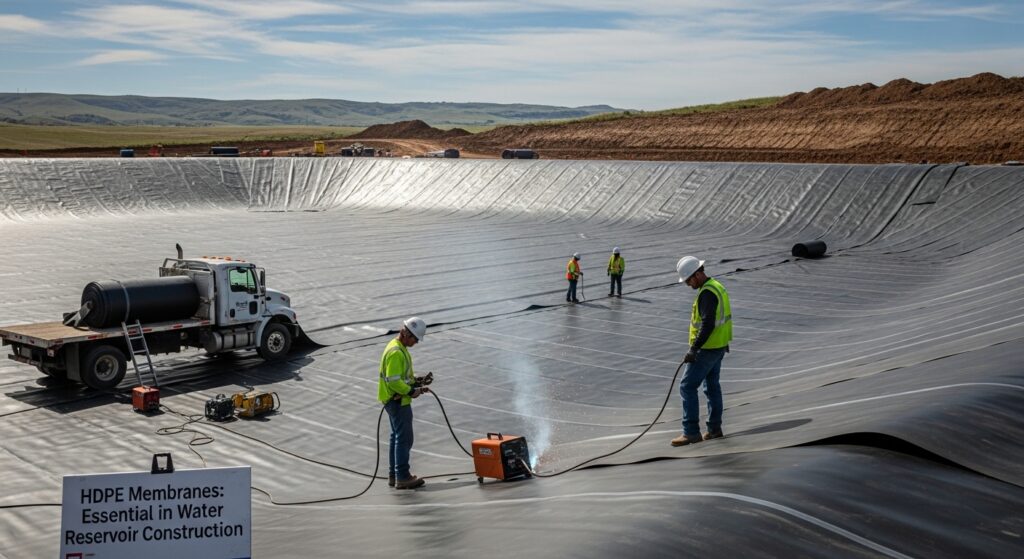
HDPE membrane reservoirs are gaining prominence in the modern projects due to the fact that it offers a better waterproofing layer with no parallel in terms of durability. The geomembranes are made of High-Density Polyethylene (HDPE), which is used as a water-proof barrier against the leakage of water into the ground and are therefore useful in new construction and repair of the old reservoirs.
The engineers prefer HDPE because of its:
- High chemical resistance
- Long lifespan
- Installation flexibility
- Adaptability to a range of the soil conditions
This renders it incredibly useful in comparison with conventional sealing processes as well.
Advantages of HDPE Geomembranes
HDPE liners when applied as waterproofing membrane in reservoirs have a number of advantages:
1. Excellent Waterproofing
The geomembranes of HDPE do not allow seepage because they create an impermeable layer. This minimizes the loss of water.
2. Long-Term Durability
They are resistant to UV radiations, temperature variations, and chemical reactions which make them last as long as up to 30–50 years. This renders them as one of the trustworthy contemporary reservoir engineering materials.
3. Cost-Effective Installation
Installation of HDPE liner is quicker and in many cases cheaper compared to constructing thick clay cores or repair of concrete.
4. Versatile Application
They are applicable in big dams, small ponds, irrigation ponds, and industrial reservoirs. This is an addition to the total HDPE liner advantages.
5. Low Maintenance
HDPE membranes have a low maintenance cost, which minimizes the operation cost in the long run and keeps the water storage efficiency unchanged.
Optimal Possibility of Materials
Engineers today are fond of using both conventional and highly core materials to attain the best performance. The combinations available are some of the best:
- Large dams that require strength and waterproofing: Concrete structure + HDPE geomembrane
- Clay core reservoir: Clay + HDPE to enhance impermeability
- Water storage: Soil embankment + geomembrane to minimize seepage and erosion
The combination of the right water reservoir materials increases the durability of project, makes them safer and energy-saving.
Conclusion
HDPE geomembranes have transformed water-reservoir construction, offering superior waterproofing, durability, and cost-effectiveness compared to traditional materials. They minimize water loss and provide reliable storage in dams, irrigation ponds, industrial tanks, and municipal reservoirs, ensuring long-term efficiency and structural stability.
NM GEO SYNTHETIC is a trusted geosynthetics manufacturing and supply company, providing premium-quality HDPE geomembranes designed to meet international construction and environmental standards. For product details, technical support, or project inquiries, contact NM GEO SYNTHETIC — your reliable partner for advanced water-storage lining solutions.